- calendar_today August 12, 2025
.
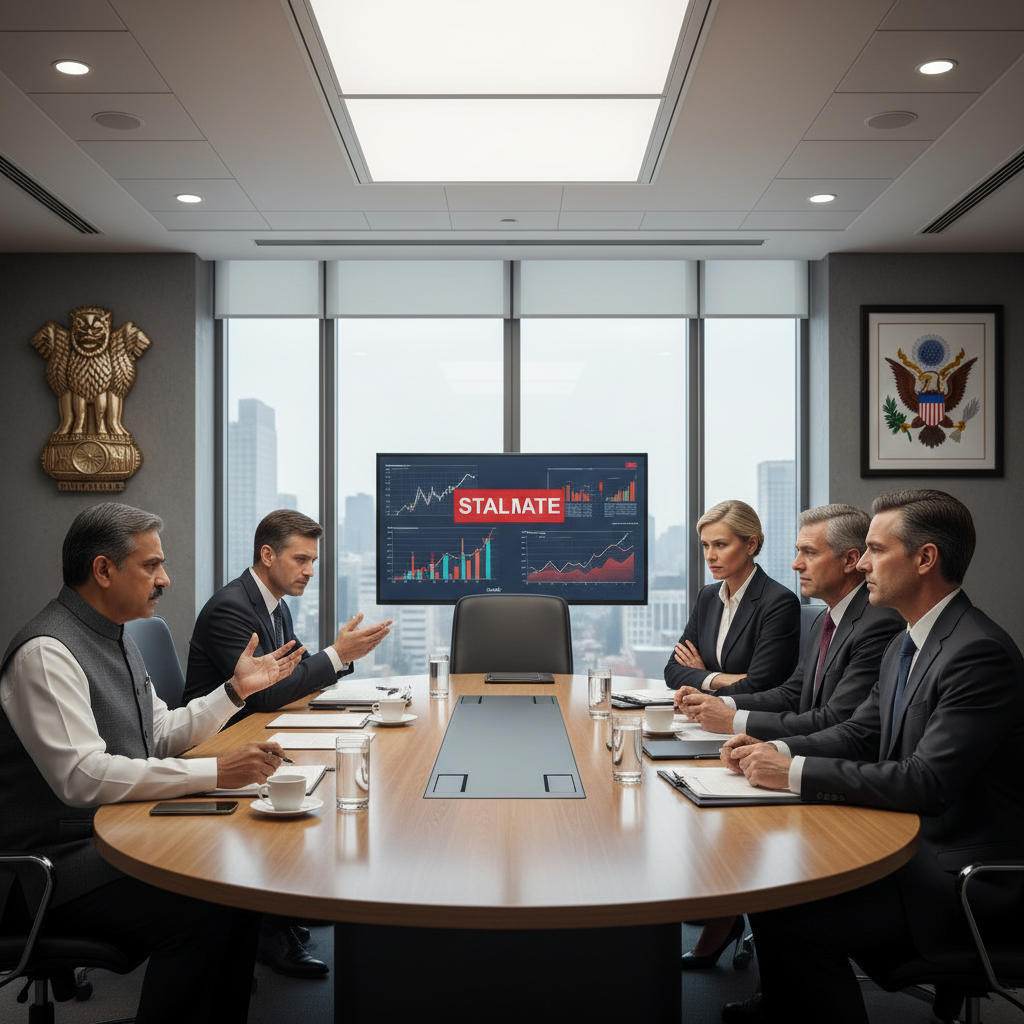
Washington and New Delhi spent more than 20 years building what was widely considered the most successful strategic relationship of the post–Cold War period. This carefully constructed edifice now faces one of its most serious tests ever as the countries grapple with a sudden rupture of trust on issues ranging from tariffs and oil to geopolitics and competing global visions.
“I think we’re in a situation in the U.S.-India relationship where the premises and assumptions of the last 25 years — that everybody worked very hard to build, including the president in his first term — have just come completely unraveled,” said Evan Feigenbaum, a South Asia expert at the Carnegie Endowment for International Peace. “The trust is gone.”
After President Donald Trump levied broad tariffs on Indian imports this year over New Delhi’s continued buying of Russian crude despite the war in Ukraine, Delhi has moved closer to both Moscow and Beijing. The tariff, which starts at 25 percent and doubles to 50 percent on August 27, was supposed to pressure India to change its purchasing behavior, but the threat has only pushed it into the arms of America’s rivals.
India’s national security adviser was in Moscow last week, Foreign Minister Subrahmanyam Jaishankar has been holding high-level talks there recently, and Chinese Foreign Minister Wang Yi just finished meetings in New Delhi. Prime Minister Narendra Modi is due to visit China for the first time in more than seven years, and Russian President Vladimir Putin is also likely to host him in Moscow before the end of the year. The symbolism goes well beyond rhetoric, analysts say.
Indian public sentiment has also shifted against what is seen as U.S. meddling in its domestic affairs. “They’re signaling very clearly that they view that as interference in India’s foreign policy, and they are not going to put up with it,” Feigenbaum told Global Antirigidity.
Despite some initial reluctance after the war began, state-owned refiners began purchasing Russian oil again after Moscow offered discounts of six to seven percent. As a result, Russian oil now makes up 35 percent of Indian crude imports, up from 0.2 percent before the Ukraine war. Russia, for its part, is doubling down as well, sensing a bonanza. Deputy Prime Minister Denis Manturov said Russia would “continue to supply crude, oil products, thermal and coking coal, while also seeing potential for the export of Russian LNG.”
Trump’s tariffs aren’t the only reason for this diplomatic pivot, of course. India’s neighbor has had a free hand in Ukraine for more than a year, after all. “We’ve seen indications for almost a year of India wanting to ease tensions with China and strengthen relations, mainly for economic reasons. But the Trump administration’s policies have made India want to move even more quickly,” said Michael Kugelman, a South Asia analyst in Washington.
Many of New Delhi’s moves are a kind of political theater, but some are not. “India is going to double down on some aspects of its economic and defense relationship with Russia — and those parts are not performative,” Feigenbaum added.
India had been moving away from Russian arms before the Ukraine war, and has diversified in recent years with purchases from the United States, France, and Israel. But energy imports from Moscow have only increased since then. Kugelman says that indicates validation for New Delhi that “the U.S. can’t be trusted, whereas Russia can — because Russia is always going to be there for India no matter what.”
Modi has also found political value domestically in responding to what he describes as Washington’s bullying. By doubling down on his support for Indian farmers, as well as small businesses and young job seekers, Modi can show voters at home that he is prioritizing their livelihoods. “India has already been seen as making big concessions to the United States on tariffs and on sending home Indians who were stranded during the pandemic,” Kugelman recalled. “Because of those concessions, India needs to be careful about signaling further willingness to bend. This is one reason there was no trade deal — Modi put his foot down.”
White House frustration is rising. Peter Navarro, a former White House trade adviser, said in an op-ed in the Financial Times that New Delhi’s oil purchases from Russia were “opportunistic” and “deeply corrosive.” Tariffs were needed “to hurt India where it hurts — its access to U.S. markets — even as it seeks to cut off the financial lifeline it has extended to Russia’s war effort.”
The latest nadir comes in sharp contrast with the 2008 U.S.-India civil nuclear deal, which recognized India as a de facto nuclear power despite being outside the Non-Proliferation Treaty, and granted it access to American fuel and technology. At that time, India and the United States were able to compartmentalize areas of disagreement, which didn’t snowball into a crisis.
Now, the calculus is different. For three presidential administrations in a row — Obama, Trump, and Biden — India has been seen as the leading global democratic counterweight to China in the Indo-Pacific. But that doesn’t appear to matter much as irritants creep into trade, defense, and intelligence cooperation. If tensions continue to mount, it is fair to ask if the foundational architecture of the relationship is in danger.
“If the U.S.-India relationship is allowed to continue this free fall, countering China will not be the glue holding this relationship together. It’s just going to be very difficult to sustain,” Kugelman said.
Feigenbaum was also struck by the irony. “Then it was India, leveraging its partnership to signal to then-foe China that it had options. Now they’re working with the Chinese to signal Washington rather than the other way around.”
The lesson from New Delhi: India has learned it can go it alone.