- calendar_today August 16, 2025
.
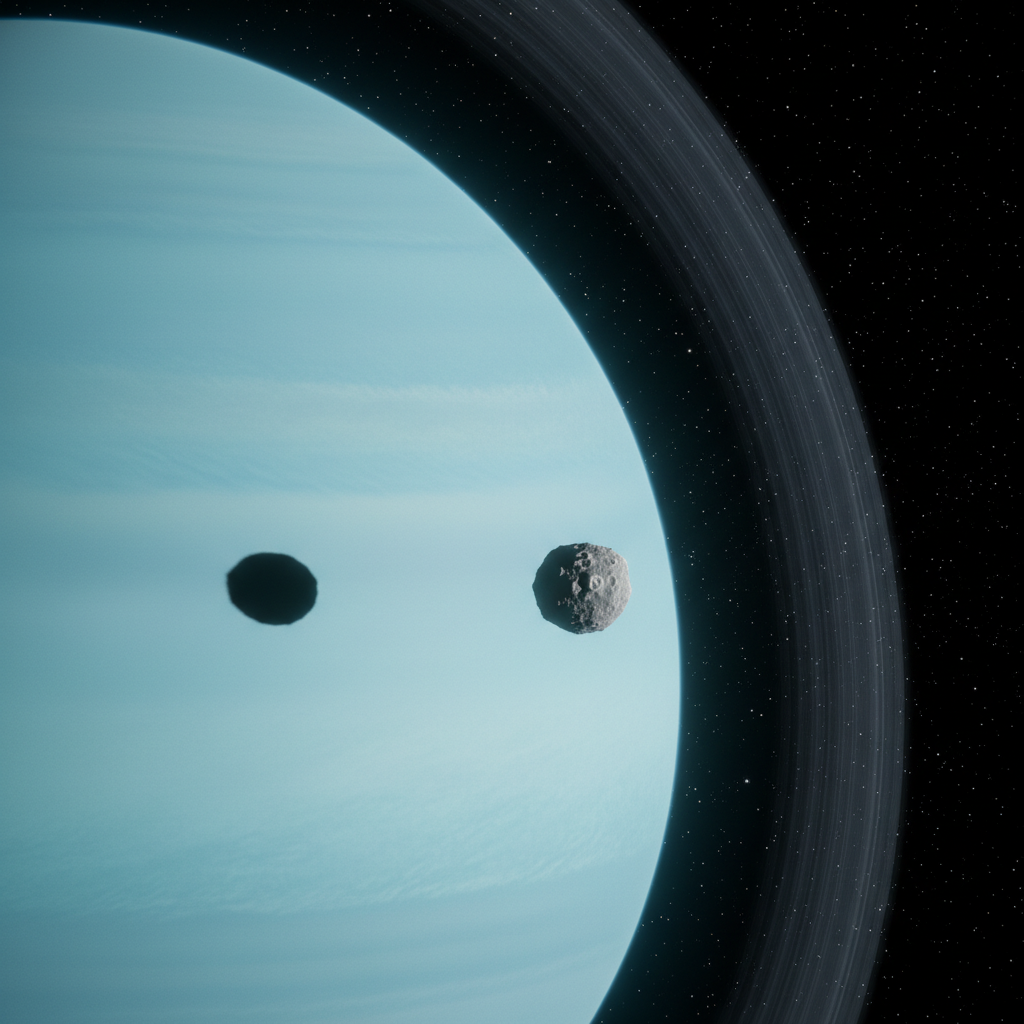
Astronomers using the James Webb Space Telescope (JWST) have discovered a new, previously unknown moon around Uranus, bringing the total number of moons orbiting the ice giant to 29, and are confident more are out there.
Webb astronomers revealed the discovery of the tiny, 6-mile-wide (10 km-wide) world on Feb. 2 in a series of 40-minute-long-exposure images taken by Webb’s Near-Infrared Camera. The new moon is one of the smallest natural satellites found around Uranus yet and was hidden from previous missions and telescopes due to its small size and the glare from the planet’s bright rings. Voyager 2 spacecraft’s historic flyby of Uranus nearly 40 years ago even missed it.
“This is a small moon but a significant discovery,” said Maryame El Moutamid, a lead scientist at the Southwest Research Institute’s Solar System Science and Exploration Division in Boulder, Colorado. El Moutamid is also a principal investigator (PI) of a Webb program to study Uranus’ rings and inner moons. She added that it shows how Webb is enhancing knowledge well beyond the discoveries of previous missions.
Webb Spotted the Dark, Tiny, Fast-Moving Object
Astronomers struggled to distinguish the dark, tiny, and fast-moving object against Uranus’ bright rings and glare. “With its exquisite sensitivity, Webb revealed the new moon by detecting its faint infrared light,” the team explained in a statement.
The new find follows a series of discoveries of Uranus’s rings, weather, atmosphere, and first close-up views of the rings using Webb, as the telescope “writes the next chapter of a book about Uranus,” scientists said.
Unlocking the Secrets of Uranus’ Intriguing Moons and Rings
The discovery of this new moon will enable scientists to study Uranus’ dynamic inner system in even greater detail, including studying the origin of the planet’s ring system, which may have formed in the same event that birthed S/2025 U1. “This discovery raises questions about how many more small moons remain hidden around Uranus and how they interact with its rings,” El Moutamid said.
At the time of discovery, Uranus was known to have five big moons, Miranda, Ariel, Umbriel, Titania, and Oberon, and a cluster of smaller satellites. The new object is now the 14th small moon in that inner system. There are no other planets with as many small inner moons all clustered so closely together, which puzzles scientists. Satellites orbiting so near each other should have unstable orbits, and the moons’ orbits should cross, but for some reason, they are all stable. Astronomers believe the system’s small inner moons act as shepherds to keep the planet’s narrow rings in place.
“In addition to being small, S/2025 U1 orbits very close to the planet, so it’s a really exciting find,” Scott Sheppard, an astronomer at the Carnegie Institution for Science who was not involved in the new study, but co-discovered one of Uranus’ moons in 2024, said. “Its close connection to Uranus’ inner ring system is particularly interesting,” he added, also praising Webb’s sensitivity.
“Finding new small moons around Uranus helps reveal a blurry boundary between its moons and ring system, as well as complex inter-relationships that hint at a chaotic past,” said Matthew Tiscareno, a planetary scientist with the SETI Institute and co-principal investigator (co-PI) in the Webb Uranus project. Tiscareno added that the moon is even smaller and fainter than the tiniest known Uranian inner moons. “We are confident there is more to be found,” he said.
Moon discoveries around Uranus have been revealed slowly over time. Before Voyager 2’s historic close flyby in 1986, only five moons (the largest) were known, with the first three discovered as far back as 1787. Voyager 2 discovered 10 additional moons in a pass, with diameters ranging from 16 to 96 miles (26 to 154 km), and additional ground-based telescopes and the Hubble Space Telescope later spotted another 13 small moons, which range from 8 to 10 miles (12 to 16 km) across and are darker than asphalt. The inner moons are believed to be a mix of ice and rock, while the captured asteroids that make up Uranus’ moons beyond Oberon are most likely made of rock.
The Future of Uranus Exploration
Future exploration of Uranus could continue. A planetary decadal survey published in 2022 by the National Academies of Sciences, Engineering, and Medicine recommended NASA’s next big planetary project to be a Uranus Orbiter and Probe mission. The mission could launch as early as the 2030s, if funding for the mission survives ongoing budget debates. The mission will study Uranus’ tilted rotation, complex magnetic field, and atmospheric dynamics, and could also explore icy ocean worlds that may exist among the planet’s moons.
Sheppard noted that “additional moons only a few kilometers across likely remain to be discovered,” either with long-exposure Webb imaging or in a future spacecraft mission. El Moutamid and her team will continue to work on narrowing down the S/2025 U1’s orbit and continue to search for more hidden moons.
“Discovering a new moon around Uranus helps scientists better understand how its strange system formed, sheds light on its rings, and is a step toward preparation for future missions like NASA’s Uranus Orbiter and Probe,” El Moutamid said.