- calendar_today August 17, 2025
On the morning of March 10, 2023, Donald Trump found himself under unusual scrutiny. The former U.S. president was holding a press conference at the Mar-a-Lago resort, where he was selling a recent trade deal between the United States and the European Union. He was making some of his standard gaffes, like the claim that a Scottish wind turbine company was based in Houston, Texas. But the part that drew most of the attention concerned renewables. “Wind turbines are just a con job,” he said. “They drive the whales loco. And what do the whales do when they go loco? They kill all the fish. And the birds go crazy. You know they kill birds, right? Bird populations are just way down. It’s the wind turbines. And it kills people. It kills lots of people.”
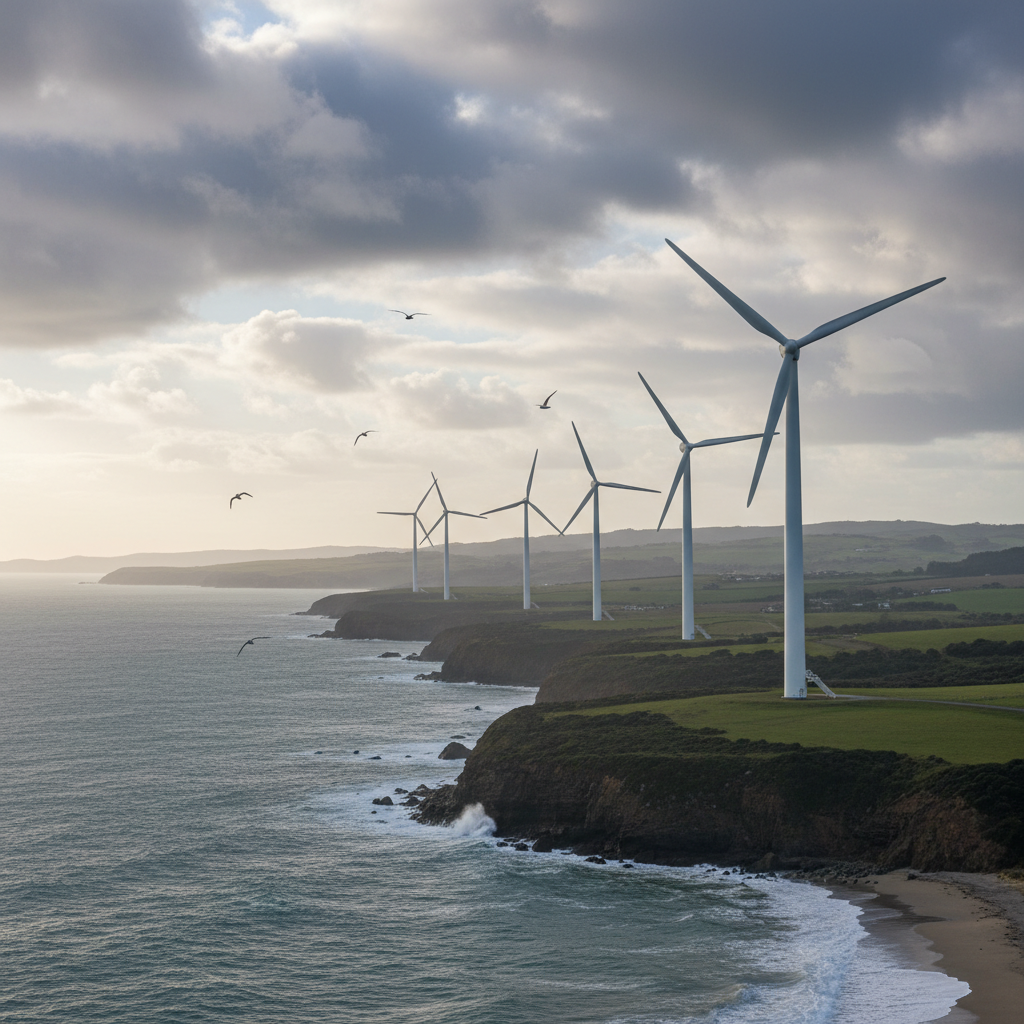
Wind power’s bête noire. Photo: Wikimedia, CC BY-SA 3.0.
Trump’s performance was theatrical, and there is always a risk of giving too much attention to his tweets and tirades. But his wind turbine aside was not random. In the past, he has characterized them as “enemies of the people” and “necklines,” a misspelling of necklaces, because “They say they bring in, like, energy, but I don’t think so.”
Framing wind turbines as windmills is nothing new and has become something of a battle cry among climate deniers in the United States. Even Trump’s more outlandish claims also have some precedent in conspiracy thinking about renewable energy.
The allusion to whales going “loco” echoes a real fear from the 1970s, when researchers reported unusual mass beachings of pilot whales in Germany and other countries. News articles about the strandings became fodder for conspiracy theorists in the 1980s, who pointed to a possible connection between offshore wind turbines and the whales’ deaths. Although it later became clear the strandings were the result of a viral infection, fear of wind turbine syndrome has become a cultural meme.
The same can be said of his assertion that wind farms cause bird deaths and lower populations. Such claims were front and center in the early days of wind power, particularly in Europe, where large-scale farms were first deployed. Public awareness of wind turbines’ impact on birds is in decline, but remains more than three times higher in countries like Germany and Denmark, which were early wind energy adopters.
He is not the first person to raise fears over bird deaths and renewable energy. In 2022, then French President Emmanuel Macron issued a decree temporarily halting new projects at sites with major bird habitats in an effort to appease a growing coalition of right-wing opponents. Trump’s insinuation that wind turbines lead to power outages also has some basis in a 2021 case where winds knocked out electricity in a part of Germany. They have also faced frequent disruptions over the past two years in Texas due to a lack of winterization.
Wind power’s weaponization in culture wars
The sentiment that renewables are a problem rather than a solution is not new, nor is it confined to the United States. Wind turbine syndrome has been used as shorthand for climate fearmongering for some time, including in articles in the New York Times, The Guardian, the National Post, and many other publications. Elsewhere in the world, these campaigns are backed by more formal conspiracy theories. A prominent example is the storm conspiracy, or the theory that the climate movement is setting up the country for invasion by the United Nations or other outside forces.
In both the U.S. and overseas, such messages have attracted followers and helped seed divisions over the energy transition and clean energy development. We are now seeing this reflected in opinion polling, where support for wind energy is in decline in some places while opposition is on the rise.
But how did a technology come to such a state of disrepair in the public’s imagination? And why did this opposition become so politicized?
The reason for the populist backlash against renewables is not hard to spot. A shift away from fossil fuels toward low-carbon energy is likely to mean profound changes in how our societies work. Energy transitions have also historically been used as a tool of oppression, as recent research on the oil industry in Iraq has shown.
Fear of technological change is not new. There have been recurring public anxieties over technological change and scientific progress in the Western world. These run from the 19th-century fear that telephones would spread diseases to more modern concerns about “geek girls.”
But once fears take root in a person’s worldview, countering them with facts is not always the best solution. In some cases, studies have shown that debunking specific claims can actually make matters worse. Scientific knowledge does not always make its way to the grassroots level.
Government, business, and institutions face a similar issue as they attempt to speed up the shift to clean energy. People will always have different opinions and views, and that is normal. The question is how governments and institutions respond. Do they listen and work with communities? Or do they choose to ignore or override them? In cases where the latter is the case, tensions and oppositions may be inevitable.